
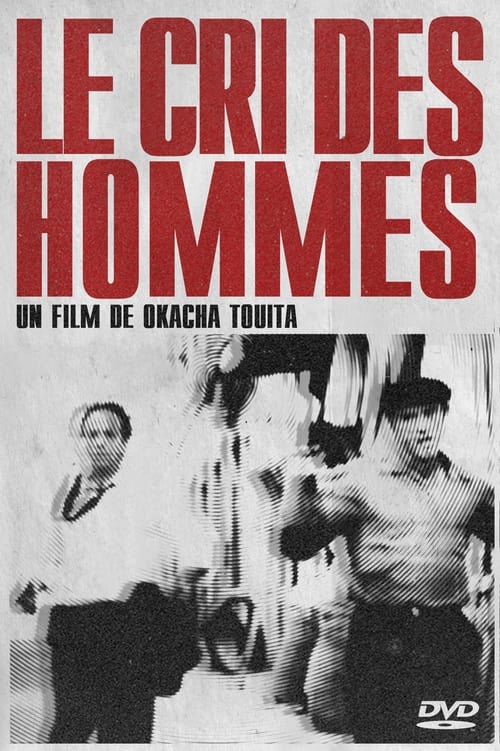
Le Cri des hommes
Overview:
1957, the town of Mostaganem, Algeria: the country is still under French occupation, and repression of the National Liberation Front is at its height. The authorities indulge in torture, intimidation and public executions.
Recommendations for you

The First Man
Based on a novel that Albert Camus was working on when he died, we follow Jacques Comery as he travels back to Algeria in 1957, a place full of childhood memories. The country is split between those wanting to remain a part of France, and those demanding independence. Reminiscences of his mother, his stern grandmother and a young Arab boy come flooding back.

DNA
A woman has a close bond with her beloved Algerian grandfather, who protected her from a toxic home life as a child; his death triggers a deep identity crisis as tensions between her extended family members escalate, revealing new depths of resentment and bitterness.

The Stranger
Algiers, 1938. Meursault, a quiet and unassuming employee in his early thirties, attends his mother's funeral without shedding a tear. The next day, he begins a casual affair with Marie, a work colleague. He quickly slips back into his usual routine.

Intimate Enemies
A drama following a French platoon during Algeria's war of independence.

Days of Glory
1943. They have never stepped foot on French soil but because France was at war, Said, Abdelkader, Messaoud and Yassir enlist in the French Army, along with 130,000 other “indigenous” soldiers, to liberate the “fatherland” from the Nazi enemy. Heroes that history has forgotten...

Cléo from 5 to 7
Agnès Varda eloquently captures Paris in the sixties with this real-time portrait of a singer set adrift in the city as she awaits test results of a biopsy. A chronicle of the minutes of one woman’s life, Cléo from 5 to 7 is a spirited mix of vivid vérité and melodrama, featuring a score by Michel Legrand and cameos by Jean-Luc Godard and Anna Karina.

Omar Killed Me
In the summer of 1991 an elderly woman Ghislaine Marchal is found murdered in the basement of her home with the message "Omar M'a Tuer" (Omar has kill me) written beside in her own blood. Despite a lack of forensic or DNA evidence, her Moroccan gardener Omar Raddad is found guilty and sentenced to 18 years in a French prison. Shocked by the case, and convinced of his innocence, journalist Pierre-Emmanuel Vaugrenard moves to Nice to investigate, and uncover the truth...

Promises
Clémence, the fearless mayor of a town near Paris, is completing the final term of her political career. With her faithful right-hand man Yazid, she has long fought for this town plagued by inequality, unemployment and slumlords. However, when Clémence is approached to become Minister, her ambition arises, questioning her devotion and commitment to her citizens. Will her political integrity and election promises survive her newly found ambition?

The Wind and the Lion
At the beginning of the 20th century an American woman is abducted in Morocco by Berbers, and the attempts to free her range from diplomatic pressure to military intervention.

Mesrine: Killer Instinct
Jacques Mesrine, a loyal son and dedicated soldier, is back home and living with his parents after serving in the Algerian War. Soon he is seduced by the neon glamour of sixties Paris and the easy money it presents. Mentored by Guido, Mesrine turns his back on middle class law-abiding and soon moves swiftly up the criminal ladder.

Line of Demarcation
It is based on upon the memoir Mémoires d'un agent secret de la France libre et La Ligne de démarcation by Gilbert Renault under his pseudonym Colonel Rémy. A small village in the Jura is split by the river Loue which creates the line of demarcation between Nazi occupied France and freedom. A French officer, Pierre, is released by the Nazi soldiers to find his chateau converted into a German command centre. Whilst he is obliged to co-operate with the enemy, his wife Mary supports the resistance movement and is willing to risk her life for it. The Nazis step up their activity against the resistance, insisting that any who attempt to cross the line of demarcation will be shot. When his wife is arrested, Pierre decides to switch his allegiance.

Michou d'Auber
Set in France during the struggle for Algerian independence, Messaoud's mother is terminally ill and his father, needing to work long hours in the factory, can't look after him, so decides to put him and his older brother Abdel in foster care. Sent to the countryside, Abdel has to work on a farm, but Messaoud is taken in by a childless woman, who conceals his Arab origins from her fiercely Gaullist ex-army husband. Re-named Michel/Michou, and with his hair comically dyed blond, the young boy quickly steals the hearts of both foster-parents, and eventually is instrumental in saving their troubled marriage.

The Marchers
In 1983, in France experiencing intolerance and racial violence , three young teens and the priest Minguettes launching a largely peaceful march for equality and against racism, over 1,000 km between Marseille and Paris . Despite the difficulties and resistance encountered, their movement will bring about a real boost of hope in the way of Gandhi and Martin Luther King. They unite with their arrival more than 100 000 people from all walks of life and give France its new face.

Jacquou the Rebel
In 1815, young Jacquou lives an idyllic peasant life with his parents in the Périgord region of France. But one day, his childhood happiness is cruelly ended when his father is arrested, after a dispute with the arrogant Count de Nansac. With both his parents dead, Jacquou is adopted by Bonal, a kind priest, under whose influence he grows into an assured, morally upright young man. Now an adult, Jacquou has one desire. To repay the Count de Nansac for the evil he once inflicted on his parents...

For My Country
Aissa, a young officer of Algerian origin, tragically loses his life during a fresher initiation ritual at the prestigious French military academy of Saint-Cyr. As the death tears through his family, controversy arises over Aissa’s funeral plans when the Army refuses to take responsibility. Ismael, his older, rebellious brother, tries to keep the family united as they fight to win justice for Aissa.

The Insult
After an emotional exchange between a Lebanese Christian and a Palestinian refugee escalates, the men end up in a court case that gets national attention.

Betty
A drunken, self-destructive woman called Betty wanders into a Parisian bar where she meets middle-aged alcoholic Laure. Laure decides to take care of Betty. Recovering in a hotel room, Betty begins to recount to Laure the story of her bourgeois life and her unhappy and unfaithful marriage.

Moulin
In June 1943, Jean Moulin, leader of the French Resistance, is arrested while attempting to reunite the forces of the "Armée Secrète." Interrogated by Klaus Barbie, the head of the Gestapo in Lyon, Moulin is drawn into a relentless confrontation.

A Dry White Season
During the 1976 Soweto uprising, a white school teacher's life and values are threatened when he asks questions about the death of a young black boy who died in police custody.

A Man of His Time
September 1940. Henri Marre arrives alone in Vichy as the authoritarian regime settles in. Broke, estranged from his family, and carrying copies of his self-published manifesto Notre Salut (Our Salvation), the 49-year-old is determined to secure what he believes is his rightful place in the new administration. In his writing, Henri sets out his patriotic convictions and his engineer’s methodology: efficiency above all. Claiming he wants to help save France after defeat, he does whatever is required to remain useful, serving the machinery of the new order with increasing skill. But he may be pursuing something more urgent: escape from his own ruin